The Mist and the Masonry: Finding Wisdom in the Rebuilding
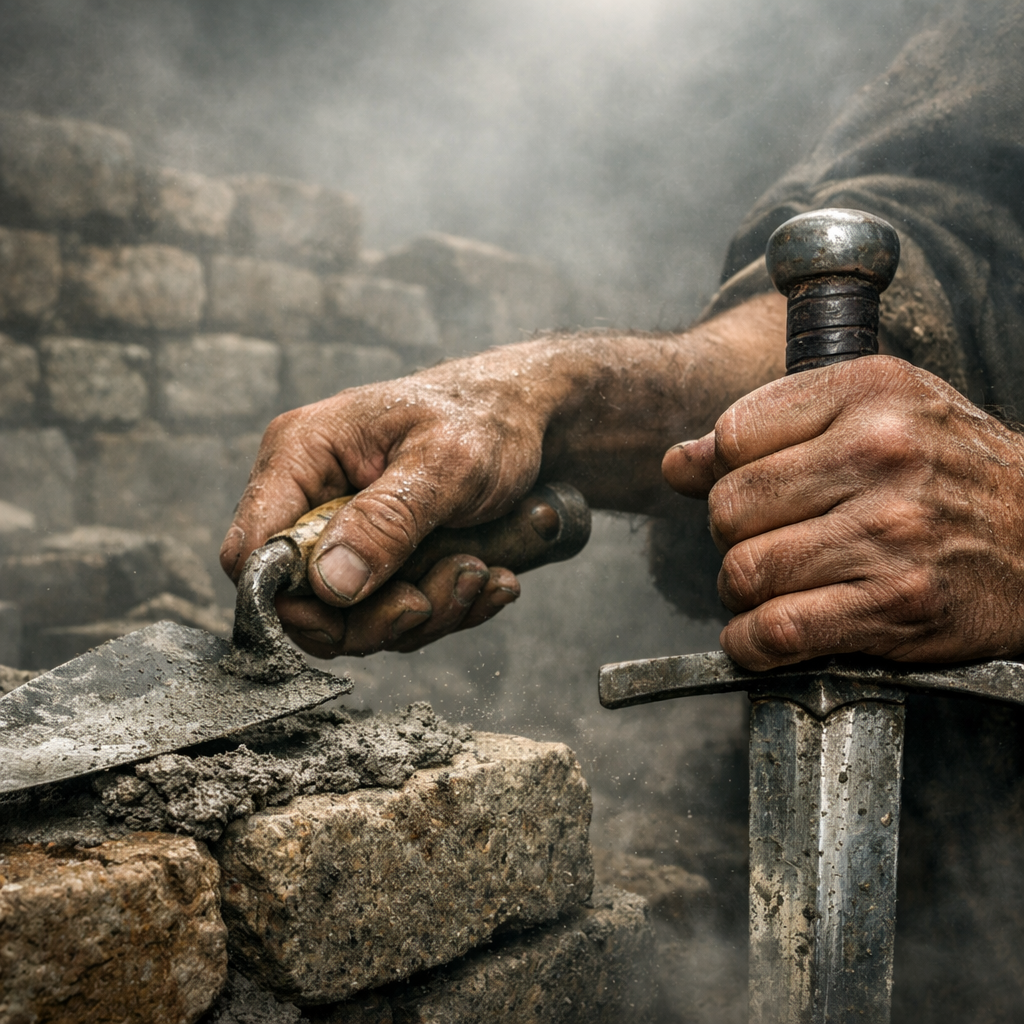
hands of craft and battle
In the first few months after separating from my husband, my house felt surreal, too quiet. My thoughts were louder than the room. The pictures on the wall, the furniture we chose together, the house itself was a monument to a life that no longer existed. I wish I could tell you that post-divorce life is easy, but it isn’t.
There’s a book by Stephen King about a mysterious mist that moves into a small American town. The fog becomes a presence, descending upon the village and seeping into every corner—an unescapable, oppressive force that distorts reality itself. The fog spawns dark creatures, and the human beings living in it begin to sour as it seeps not only into the atmosphere, but inside of them. The people turn on each other, intent on destroying one another as the fog alters their thinking. They become the very monsters they once feared.
The fog destroys clarity. Its heaviness is so palpable you can almost taste it. Its goal, it seems, is to turn people angry and bitter. The people begin to believe the fog is everywhere, that the world has come to an apocalyptic, violent end.
This is how it felt at first after my divorce. The reality of my pain was ever-present. I would start laughing with a friend and then the fog would press in. I would be grading papers and the intrusive thoughts would return. I had to fend off the attacks of my own mind—the lies that I was unworthy, undesirable, that somehow this was what I deserved.
The goal after divorce, or after any kind of trauma, is to not descend into the darkness of your own thoughts. It is all too easy to become angry, to turn that anger outward or inward, to blame the world or yourself. But the goal is not to blame. The goal is to heal, to recognize that there is something to learn even in the worst of our experiences.
When I left my marriage, I had chosen correctly. My husband had confessed an affair. He told me he was stopping it, but he didn’t. To stay would have meant the loss of my dignity, the loss of truth. I would have had to pretend every day that he wasn’t doing the things he was really doing. It was not a life I could live, and it likely would not have lasted long even if I had tried.
Yet, just because it was the right choice didn’t erase the pain. In some ways, it made it worse. I believed that if I did the right thing, I should reap the rewards of doing the right thing.
This is sometimes the shocking revelation of the justified: being right doesn’t make it hurt less. It does not lessen the struggle. In fact, it can make the injustice feel sharper, more personal. Why am I in so much pain when I’m doing the right thing?
Self-governance is a concept I believe in, and when we’re in pain, our training in self-governance—our patterns of survival—can steady us. We focus on today rather than allowing intrusive thoughts to take over. I will wake up and get dressed in the dark. I will go for a walk. I will make a nutritious meal for my kids even as my hands tremble. I will go to work and stay busy. It was hard, but it was a place to begin.
Rebuilding your life after collapse is a concept well worn in ancient texts, especially the Bible. The Jewish people became the forerunners of resilience, their small territory constantly under siege. The Old Testament is a series of narratives revolving around home, siege, exile, return, and rebuilding. It is the story of a people who understood that survival itself can be a form of spiritual growth, and that God can be found even in the process of rebuilding.
Just as the mist in King's story spawned monsters, Nehemiah faced 'monsters' of his own, men who used mockery and lies to destabilize his efforts to rebuild the temple. Nehemiah was a Jewish official in the Persian court. He was given permission to return and rebuild the walls of Jerusalem after the Babylonian exile. It was an exciting time, but one of extreme vulnerability. The Jews were still under Persian rule. The Persians were more permissive, but they were still in power. Enemy forces surrounded Nehemiah and his efforts, including Sanballat the Horonite, Tobiah the Ammonite, and Geshem the Arab. These figures engaged in psychological warfare, mocking the rebuilding effort: “What are these feeble Jews doing?” They belittled the work: “Even a fox climbing on it would break down their wall.” Geshem accused them of plotting rebellion against the Persian king, calling their motives and integrity into question.
The fog descends and attacks us. We question our ability, our work, our purpose. And if we listen, we can lose our will to rebuild, to grow, to move forward. The voices that surround us can become the voices within us.
“Those who carried materials did their work with one hand and held a weapon in the other.”
Self-governance is the awareness of these threats and the preparation for them. When you are vulnerable—after divorce, grief, or trauma—the rebuilding of one’s life requires wisdom. Recognizing the forces that seek to destroy our confidence, belittle our efforts, and question our integrity. We build with a tool in one hand and a defensive weapon in the other.
Nehemiah uses the Hebrew word melakhah for “work” in this passage. It is not abstract. It is daily, intentional labor. The word banah, to rebuild, carries the larger vision—the restoration of what was lost. But melakhah is where we live. It is the work of survival, and it must be protected.
After tragedy, we are all in a process of banah and melakhah. We are rebuilding what was lost in the hope that it will be stronger, more resilient, more whole. In the meantime, each day is melakhah—the daily work, the quiet fight for stability and meaning.
Self-governance is the act of holding both: the tool and the weapon. The work of rebuilding and the defense of it. This is why healing cannot be rushed. It must be built, and guarded, one day at a time.
I used to wonder why being "right" didn’t make the silence of my home feel any less heavy. I know now that the truth didn't come to rescue me; it came to give me the materials to rebuild. The silence isn't an empty void anymore. I can hear the sound of my own work, one brick at a time. The fox can mock the wall all it wants. I’m not looking at the fox. I’m too busy rebuilding.
Debby Handman is a former minister (M.Div), educator, and single mother writing from the misty crossroads of faith and survival in rural Oregon. She is the author of the acclaimed novels House on Sand and The Gambler’s Wife, and her upcoming release, House of Broken Vessels.